Overview of EU legislation on environmental assessments
The general EU acquis context
Along with legislation on nature protection, environmental impact assessment was one of the first pieces of the EU environmental acquis. The original EIA Directive was already adopted in 1985. The corresponding case-law is still applicable and has been reflected in the newer version.
The most significant difference between the EIA and SEA Directives lies in their scope: while an EIA focuses on a specific project and on the environmental consequences/impacts of that project only, an SEA applies a more general approach when looking at public plans and programmes from a variety of sectors (agriculture, forestry, fisheries, energy, industry, land use planning, etc.).
There are significant synergies between environmental assessments (the EIA/SEA Directives) and substantive elements of EU environmental law (such as the Waste and Water Framework Directives, nature protection legislation, the Industrial Emissions Directive, etc.), as illustrated by the diagramme below.
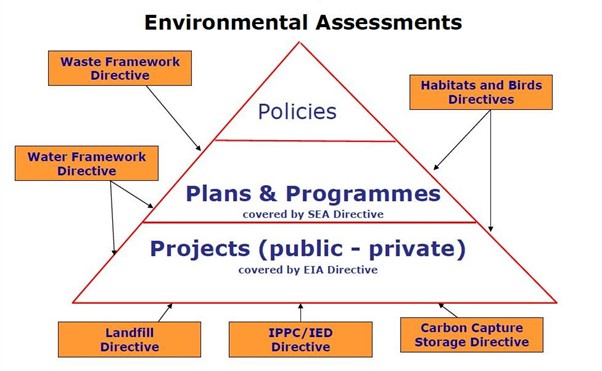
These synergies are sometimes also illustrated by significant overlaps in scope: for instance, the vast majority of industrial installations falling under the scope of the Industrial Emissions Directive (which requires an integrated permit for such installations) have to undergo, in their planning phase, an environmental impact assessment and receive development consent from the competent authority.