Judicial Review of Acts and Omissions under Art. 9(3) of the Aarhus Convention
Access to justice under Art. 9(3) of the Convention should be granted to the “members of public”, defined in Art. 2(4) of the Convention as “one or more natural or legal persons, and, in accordance with national legislation or practice, their associations, organisations or groups”. National law is thus called to specify the notion of “members of the public” and set further conditions for the members of public to access the court.
These criteria should not be too strict but they may include, for example, infringement of private interest. In a recent case, Societatea Civila Profesionala de Avocati AB & CD (C-252/22), the CJEU was asked whether the public includes a legal entity such as a law firm partnership, which does not rely on the infringement of any right or interest specific to that entity, but rather the infringement of the rights and interests of natural persons – namely the lawyers of which that partnership is comprised – [and] can such an entity be treated as a group of natural persons acting through an association or organisation for the purposes of Article 2(4) of the Convention? The CJEU answered that it is not contrary to EU law for national legislation to grant such standing under Article 9(3) of the Aarhus Convention only to environmental NGOs and to other entities only in the event of an infringement of their private interest. That provision has a broader scope than Article 9(2) of the Aarhus Convention, since it applies to a wider category of acts and decisions and is addressed to members of the general 'public'. It confers greater discretion on the Member States in establishing criteria for determining the real holders of the right to judicial protection among all members of the public. It is essential that, as a result of the criteria laid down, 'certain 'categories' of members of the public are not denied any right to a remedy. On the contrary, the need to establish a legitimate private interest merely renders inadmissible actions brought by persons who have no specific relationship with the administrative act they wish to challenge.
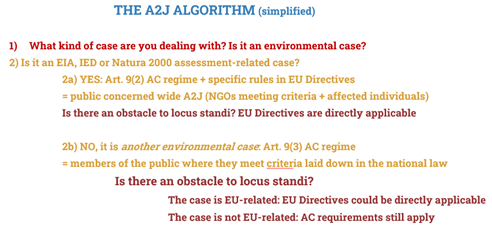
To determine which regime of the Aarhus Convention is applicable to the individual case, a simplified algorithm can be used: