The Aarhus Convention
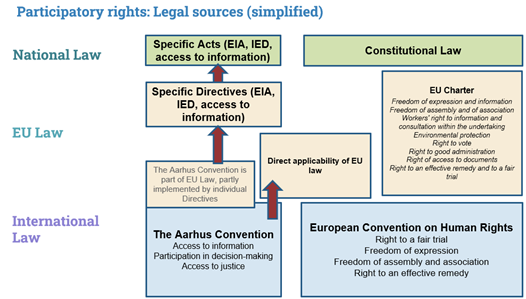
To implement the Aarhus Convention, in certain instances, EU secondary legislation specifically affords locus standi to bring actions in environmental matters before national courts in order to advance the objectives that legislation pursues (see below). In particular, the specific requirements of Art. 11 of the 2011 EIA Directive (2011/92/EU) and Art. 25 of the Industrial Emissions Directive (2010/75/EU) cover the judicial review of the decisions concerning large projects, in particular the land-use permit, the building permit, and the operation permit. These requirements are largely copied from the Aarhus Convention and, therefore, very similar. For example, both Directives guarantee the public concerned with the right to challenge the substantive or procedural legality of acts and require the proceedings to be fair, equitable, timely, and not prohibitively expensive.
However, there is no EU regulation on general access to justice in environmental matters. The Commission adopted a proposal for a Directive on access to justice in environmental matters in 2003. Still, the proposal did not gather sufficient support from the national governments and was finally withdrawn by the Commission in 2014. The Member States believed that access to national courts belonged to their competence due to the principle of subsidiarity.
The solution found by the Commission to remedy this lack of EU legislation on the matter was the publication of a soft law instrument in 2017: Notice on access to justice in environmental matters analyses the substantial existing CJEU case-law relating to access to justice in order to draw careful conclusions for: 1) national administrations who are responsible for ensuring the correct application of EU environmental law; 2) national courts, which guarantee respect for EU law and are competent to refer questions on the validity and interpretation of EU law to the CJEU; 3) the public, notably individuals and environmental NGOs, who exercise a public-interest advocacy role; and 4) economic operators, who share an interest in the predictable application of the law. In addition to this, the DG Environment prepared the Citizen’s Guide, which constitutes a simplified and shorter version of the Notice.
Since then, we have witnessed a shift in the approach used by the EU legislator, with access to justice provisions being incorporated directly into several pieces of “sectoral” legislation (Regulations and Directives), across various environmental areas.
As a result, the specific provisions aimed at ensuring effective judicial protection are currently restricted to a few areas of EU environmental law.
However, Article 47 of the EU Charter serves as a strong argument for direct applicability of EU environmental legislation if the Aarhus requirements are not implemented or if there are any obstacles to effective judicial review (see below).